
Spaced Repetition Vs Traditional Study: Definition, Differences & More

The way most of us were taught to study is one of the least effective ways to actually learn something.
We study hard the night before, walk into the exam, do okay, and forget almost everything within a week.
Nothing wrong with it, apparently, because the exams are over and you’ll likely get a decent passing grade, right?
No. That would have been right if we studied with the sole goal of passing exams. Instead, we study to actually learn something and apply that information either in our lives or in higher studies.
The traditional study method is ineffective at this. Forgetting information quickly is built into it by design.
Is there an alternative? There is, and it is called the spaced repetition method.
Let’s learn more about it in this article as we compare spaced repetition vs traditional learning to find out which one is better and why. We’ll also introduce you to RemNote, which is the best tool to implement spaced repetition using flashcards.
Let’s start.
TL;DR table
| Aspect | Traditional Study | Spaced Repetition |
| Core method | Passive consumption (reading, highlighting, re-reading) | Active recall at timed intervals |
| How memory is formed | Surface familiarity | Repeated retrieval strengthens neural pathways |
| Rate of forgetting | Steep. Most information is gone within weeks, if not days | Gradual. The curve flattens with each review |
| Study sessions | Long, exhausting, and often last-minute | Short, regular, distributed over time |
| Long-term retention | Low. Knowledge fades quickly after the event | High. Knowledge compounds and stays |
| Best for | Passing an immediate test | Long-term learning |
| Time efficiency | High upfront cost, frequent re-learning needed | Lower total time investment over the long run |
What is traditional study?
Traditional study is the default method of learning that we have been following for generations.
In this method, we simply consume information either from the teacher or the textbook, maybe highlight the important parts, and repeat this before we are tested on it.
That is traditional study in a nutshell.
Its main characteristic is that we try to consume as much information as possible. We don’t engage with the information actively.
And this is what’s wrong with the traditional learning method. When we absorb information passively, our brain tends to forget it quickly. That’s because we aren’t making a deliberate effort to recall the information when we are just passively consuming it.
As a result, our brain just treats it as unimportant and forgets it within weeks, if not days.
Researchers refer to this as the Theory of Disuse or Decay theory.
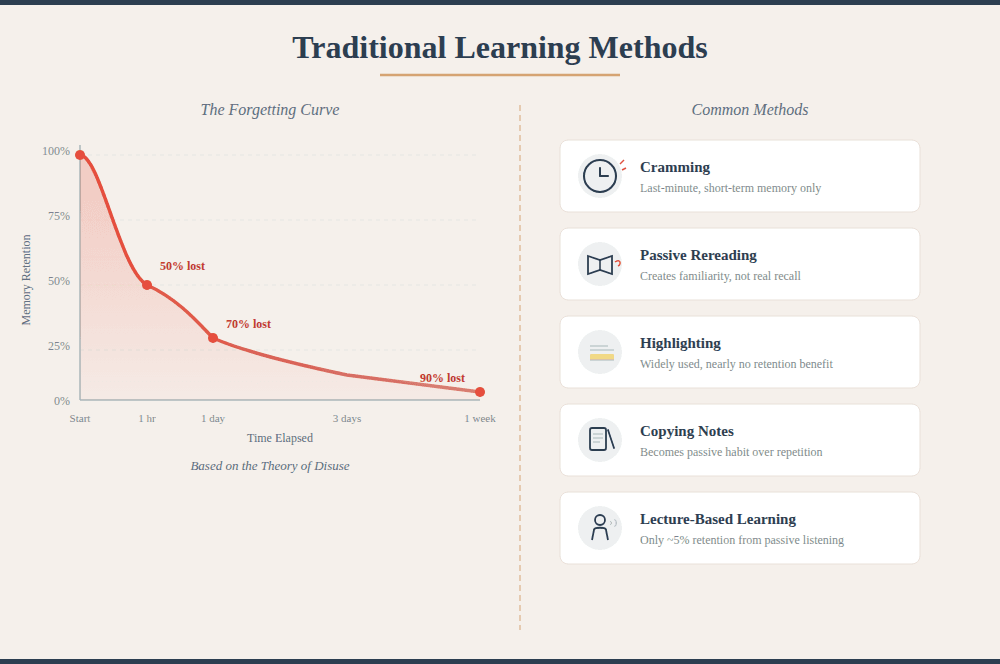
The forgetting curve that results from this kind of learning drops fast.
Research on the forgetting curve shows us that within one hour, learners forget an average of 50 percent of newly presented information, and within 24 hours, that figure climbs to around 70 percent. After a week, we have forgotten up to 90% of what we learned.
Traditional study methods
- Cramming: Conventional curricula have long favored the approach where we try to get through as much material as possible in a single sitting, the night before the exam. The learned information stays fresh in our short-term memory and is mostly gone after a few days.
- Passive rereading: In this method, we repeatedly go back through our notes or textbook a few times until the material starts looking familiar.
- Highlighting/underlining: Research shows that highlighting (marking what seems important while reading) is one of the most widely reported study strategies among students, yet it offers almost no benefit for long-term retention on its own.
- Copying and rewriting notes: Writing things out by hand does have some benefit for encoding information initially. But when you copy the same notes over and over, it becomes another passive habit that creates familiarity without building real memory.
- Lecture-based learning: This is the traditional lecture where knowledge is delivered top-down, from a teacher or instructor to students. Research suggests that this format allows learners to retain only around 5 percent of the information received because there is very little active processing happening.
What is spaced repetition?
So if traditional study fails to hold information in memory for an extended period, what is the alternative? The answer, backed by over a century of research, is the spaced repetition method.
In spaced repetition, you revisit learning material at deliberately timed intervals rather than consuming it all in one go (cramming).
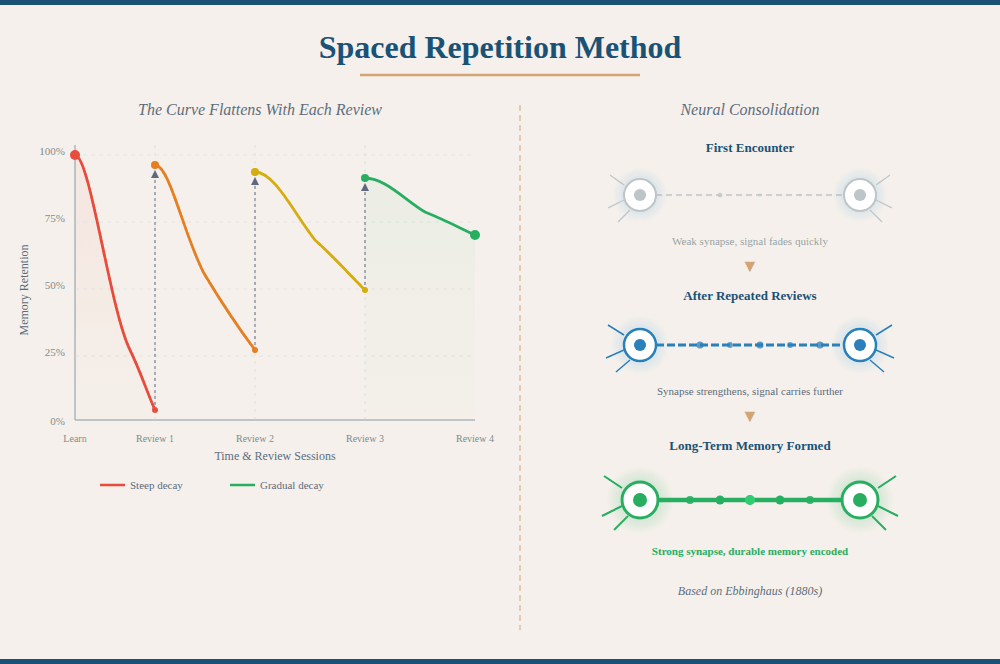
You return to the same material the next day, then a few days after that, then a week later, and so on.
Each of these sessions pushes the information deeper into long-term storage just when you are starting to forget it.
The concept was first explored by psychologist Hermann Ebbinghaus in the 1880s, the same German researcher behind the forgetting curve. His work showed that not only does memory decay rapidly without review, but that reviewing material at spaced intervals could significantly slow that decay down.
The forgetting curve slowly starts to flatten with each spaced repetition session.
Let’s show you why this method works so well.
The science of neural consolidation
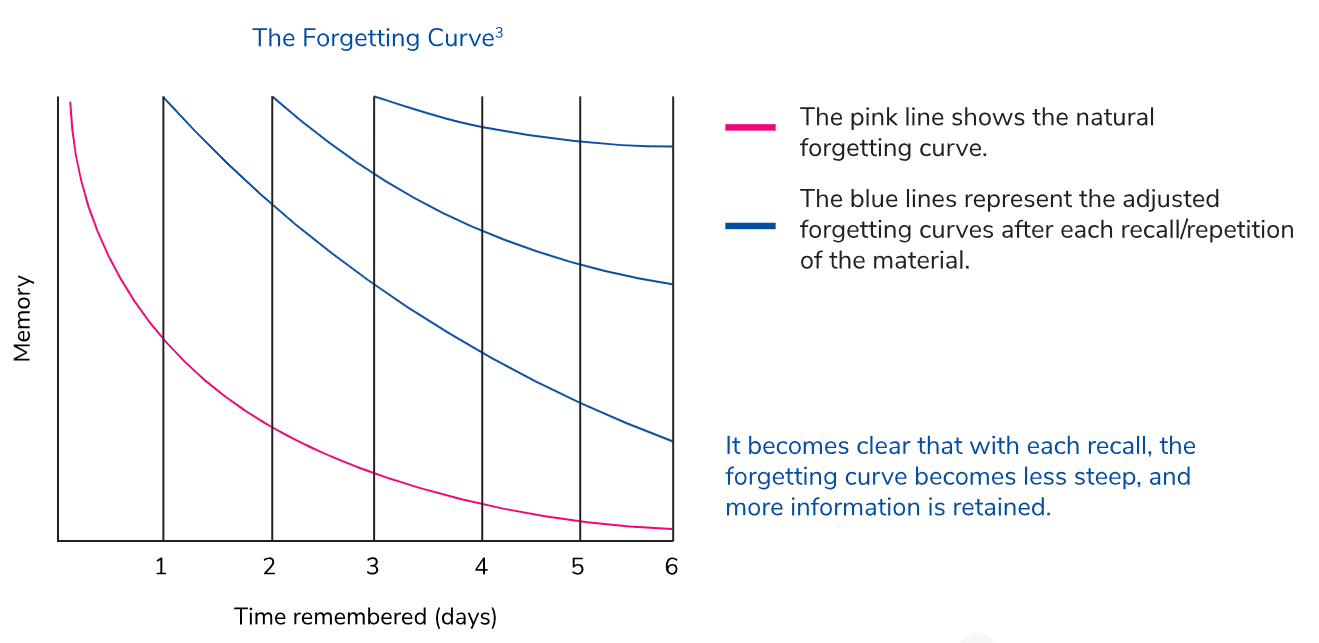
When you encounter new information, your brain begins a process called consolidation.
Consolidation is when memories move from short-term memory into long-term memory.
Remember that short-term memory is weak and temporary, and long-term memory is far more durable.
This consolidation, however, doesn’t happen easily and on its own. It takes time and biological activity at the level of individual neurons and between them.
That biological activity needs repeated activity to happen. When you repeat an activity, neurons fire together repeatedly, and the synapse between them becomes more efficient at transmitting signals.
That increased efficiency is what helps the brain encode and store memory in long-term memory.
The spaced repetition learning method is what triggers that biological activity and strengthens the connections between neurons.
When you revisit material after a gap, you are firing those neural pathways again, and each time that happens, the information etches itself deeper in your long-term memory.
In simple terms, the brain needs time between encounters with information to let consolidation do its work. Spaced repetition gives it that time and then prompts it to retrieve the memory again at just the right moment.
Differences between spaced repetition and traditional learning
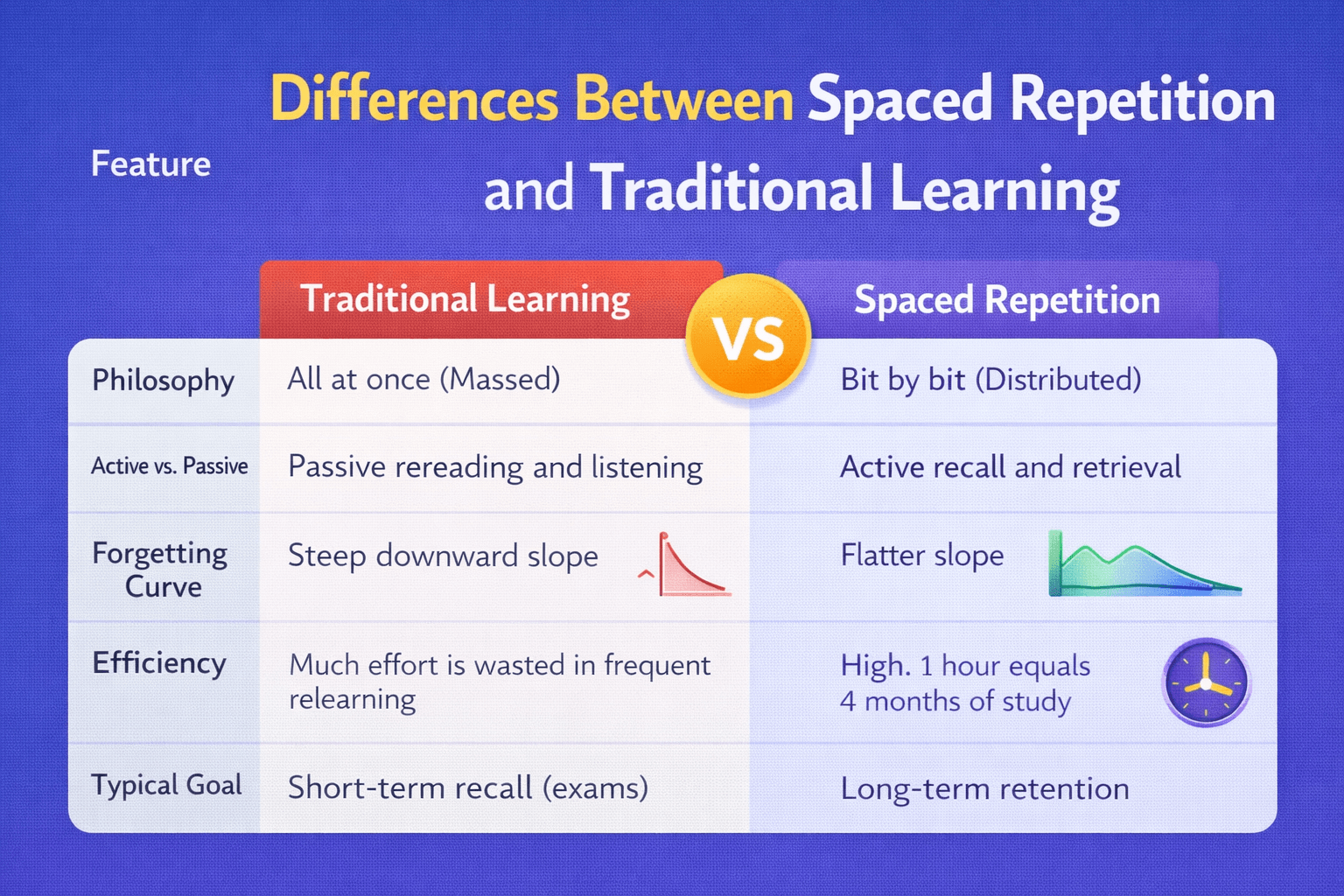
1. Active recall vs. passive review
Traditional study is built on passive review. You read through your notes, you go over the textbook, you listen to a lecture.
In all these instances, you are simply consuming information. It feels like you’re memorizing, but you’re just recognizing things you have seen before.
You feel that you’ve learned something just because it starts to feel easy and fluent to process. But that’s just recognition.
Recall is a completely different cognitive process. It refers to producing information from memory without any cues, i.e., having looked at the answer recently.
That’s what spaced repetition is built on.
Here, you force your brain to retrieve information from memory, so the next retrieval becomes a little easier.
A landmark study by Karpicke and Roediger made college students read short passages (e.g., about sea otters and the sun) in two different conditions, namely:
- Repeated study (rereading)
- Study once + repeated retrieval tests
Everyone was made to spend roughly the same amount of time studying.
The study found that students who practiced retrieval significantly outperformed those who simply reread the same material.
2. Time investment and efficiency
One of the most common objections to spaced repetition is that it involves more work.
The critics say that you are reviewing material multiple times across multiple days, whereas cramming gets it all done in one sitting.
But in reality, the opposite is often true.
A cramming session tends to be long despite being a single sitting only.
It’s also inefficient because your working memory resources become depleted as the session continues. In other words, the longer a session goes, the less you’re learning.
In contrast, spaced repetition sessions are shorter and focused on reviewing only what needs reviewing.
They also include gaps, which help with approaching the next session with a fresh focus.
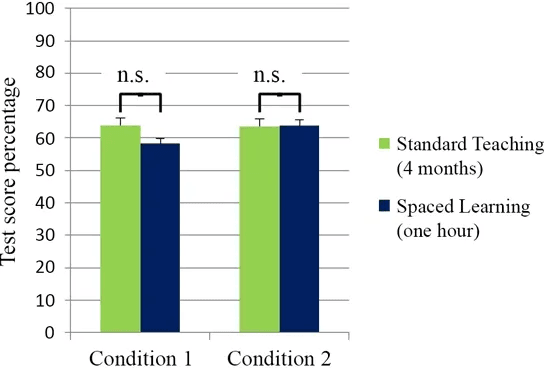
3. Rate of forgetting (the steep vs. gentle slope)
This is perhaps the starkest difference between spaced repetition vs traditional learning.
When learning is crammed, most of what was learned begins to disappear within the first day.
That’s because in cramming, there’s no strong deliberate attempt to revisit material after the initial learning event.
The brain treats the learned information as unnecessary and gradually lets it go.
This results in a steep downward slope when the forgetting curve is plotted.
However, with spaced repetition, each time you revisit material, the forgetting curve becomes flatter.
There comes a time when the curve has flattened significantly, meaning the brain won’t forget anything for a long time (months or years).
Which one is better?
Everything we covered points to spaced repetition as the better method.
It just doesn’t work for a test that’s scheduled tomorrow. For that, you have no choice but to gobble everything all at once.
But if your goal is to remember something for weeks or months down the line (which is what it should be), then no method is better than spaced repetition.
The only difference with cramming sessions is that spaced repetition cannot be applied the night before an exam. If you want to prepare for an exam using the spaced repetition method, you need to start the sessions early.
After enough repetition learning sessions, you’ll be prepared for both immediate testing as well as any assessment in the long run.
We also have extensive research that proves the value of spaced repetition vs traditional learning.
For instance, a study conducted from October 2020 to July 2023 assessed over 26,000 family physicians’ learning and knowledge transfer. It found that participants who used spaced repetition outperformed those who did not by a margin of roughly 15 percentage points (58.03% vs 43.20%) on knowledge assessments.
On top of that, the spaced-repetition group also performed better even when tested on new but related questions.
This shows that, in addition to long-term knowledge retention, spaced repetition is also better at understanding a subject in depth.
So for anything you want to actually learn and remember for a long time, spaced repetition is the better approach.
Traditional study has its place, but that place is narrow.
Spaced repetition with RemNote
By now, you might be convinced that spaced repetition is the way forward.
But do you know how to practically incorporate the method into your studies?
You might already know. When you used to study with flashcards, you were practicing spaced repetition.
And yes, spaced repetition is best practiced with flashcards.
But you cannot just sit and start making flashcards from scratch for all your subjects, can you?
That’s why we made RemNote.
RemNote combines note-taking and flashcard creation in one place. You can paste your notes or upload pictures of them to RemNote and watch them turn into digital flashcards automatically.

RemNote also schedules review sessions for you based on your performance on each flashcard. With RemNote, 1,000,000+ students like yourself are getting higher grades.

You can explore RemNote tutorials for free on the RemNote YouTube channel. And when you are ready to get started, sign up for RemNote for free today.
FAQs
How do I practically implement a spacing schedule?
The most practical way to implement a repetition spacing schedule is through flashcards. You can create a digital or physical flashcard for each concept, then review them at increasing intervals (day one, day three, day seven). Extend the gap between the cards each time you recall them correctly. You can read our guide on how to create both physical and digital flashcards and practice with them.
What tools can automate spaced repetition for me?
You can automate the spaced repetition method using tools like RemNote. RemNote generates flashcards from your notes and handles the review intervals for you based on the spaced repetition method. The tool has a dedicated flashcards hub to create, review, and track the progress of flashcards of all subjects in one place.
Can I combine both spaced repetition and traditional learning methods?
Yes, spaced repetition and traditional learning methods can be combined, and it might work well, too. You can use traditional study for your first pass through new material, then switch to spaced repetition in the days that follow to make sure what you learned sticks for long term.