
Active Recall: Science-Backed Way to Remember What You Study


You crammed your course the night before your exam, and it mostly worked. But after a few weeks, on the cumulative final exam, you couldn’t remember anything.
You might think you didn’t study the first time enough. But that’s not why this happens.
According to researchers, cramming is among the weakest ways to learn something because you’re passively going through information instead of memorizing it.
The alternative method that science suggests is called active recall. This method is backed by decades of research. Simply put, the method involves putting effort into recalling information from your memory instead of just passively reviewing your study materials.
“Practice testing (i.e., practice retrieval) is one of the most effective strategies to consolidate long-term retention of studied information and facilitate subsequent learning of new information, a phenomenon labeled the testing effect.”
- Yang et al. (2021)
You might already be practicing active recall without knowing it. But learning what the practice actually stands for and the practical ways to implement it can further improve your study sessions.
And that’s what you’ll do in this comprehensive guide. The guide will walk you through the what, the why, and the how of active recall, so you can start putting it to work right away. I’ll also introduce you to an app that makes implementing active recall almost effortless.
What is active recall?
Active recall is a learning method where, as the name says, you retrieve information out of your memory in an attempt to strengthen your memory of that specific information.
The active part means not consuming information passively as you do when you’re simply reading your notes and highlighting lines. That passive approach doesn’t improve your memory of something much.
Instead, you should ask yourself questions and force your brain to reach for the answer or reconstruct it from other bits of information you already know. This attempt to retrieve information from your memory instead of just reviewing the answer from your notes is active recall.
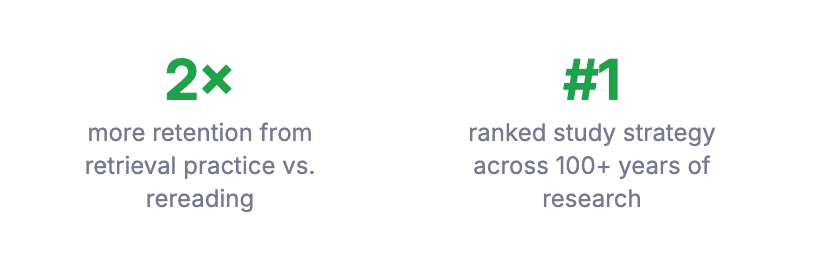
There are several ways to put active recall into practice. You can implement it with flashcards, practice tests, or by talking to yourself out loud. I’ll get into all the key ways to practice active recall in more detail in a later section.
As for what type of information is best learned with active recall, the list is quite long, but here are a few examples:
- Definitions
- Dates
- Lists
- Formulas
- Foreign vocabulary
- Facts
- Chronological events
- Diagrams
- Maps
- Poems
The mechanism of active recall
Sure, recalling information from memory strengthens your memory of it. But what’s going on inside your head that makes the strengthening possible?
The answer has to do with how our mind stores memories and re-accesses them. So there are two sides to it. Let’s go over both of them briefly:
- How the brain stores memories: Any new information that we learn gets encoded by our brains and stored between multiple neurons linked together in a specific pattern.
- How the brain recalls memories: When we want to recall the same information, the brain re-invokes that specific pattern to reassemble those neurons from different regions of the brain.
When information is retrieved through those neural pathways multiple times, those pathways become etched firmly in your mind, and the information becomes easier and faster to recall the next time.
This neural event doesn’t occur with passive study methods. That’s because in passive methods, the source of information is within your sight, so your brain doesn’t have to do the work of producing the answer on its own.
As a result, those neural pathways stay largely idle, and your memory of whatever you’re learning doesn’t improve. You simply start getting more familiar with the material for the time being, which tricks you into thinking you’ve memorized it.
You can understand it through the example of watching someone lift weights vs doing the reps yourself. The former won’t build your muscles. You have to do the reps yourself and put yourself in difficulty to get there.
The same happens in active recall. You have to give your mind the strain of retrieval for it to adapt to it.
Over time, you’ll notice that recalling something has become easier. But you don’t have to stop there. As recalling something gets easier, you should add more difficulty so the memory becomes long-term. It may also become permanent if you try hard enough.
Difficulty here can mean extending the gap between recall sessions. You deliberately take longer breaks so your memory starts to fade, then recall it just before you are about to forget it. This technique is called spaced repetition.
Now let’s talk about the science behind active recall and why it's so effective.
What does research say about active recall’s efficacy?
Active recall has been heavily researched and found to be highly effective almost every time.
Here are a few studies and what they found.
1. The Karpicke and Roediger study (2006)
This study on active recall is the most cited one on the testing effect.
Henry Roediger and Jeffrey Karpicke ran two experiments. One experiment involved 120 Washington University undergrads, and the second involved 180 of the same.
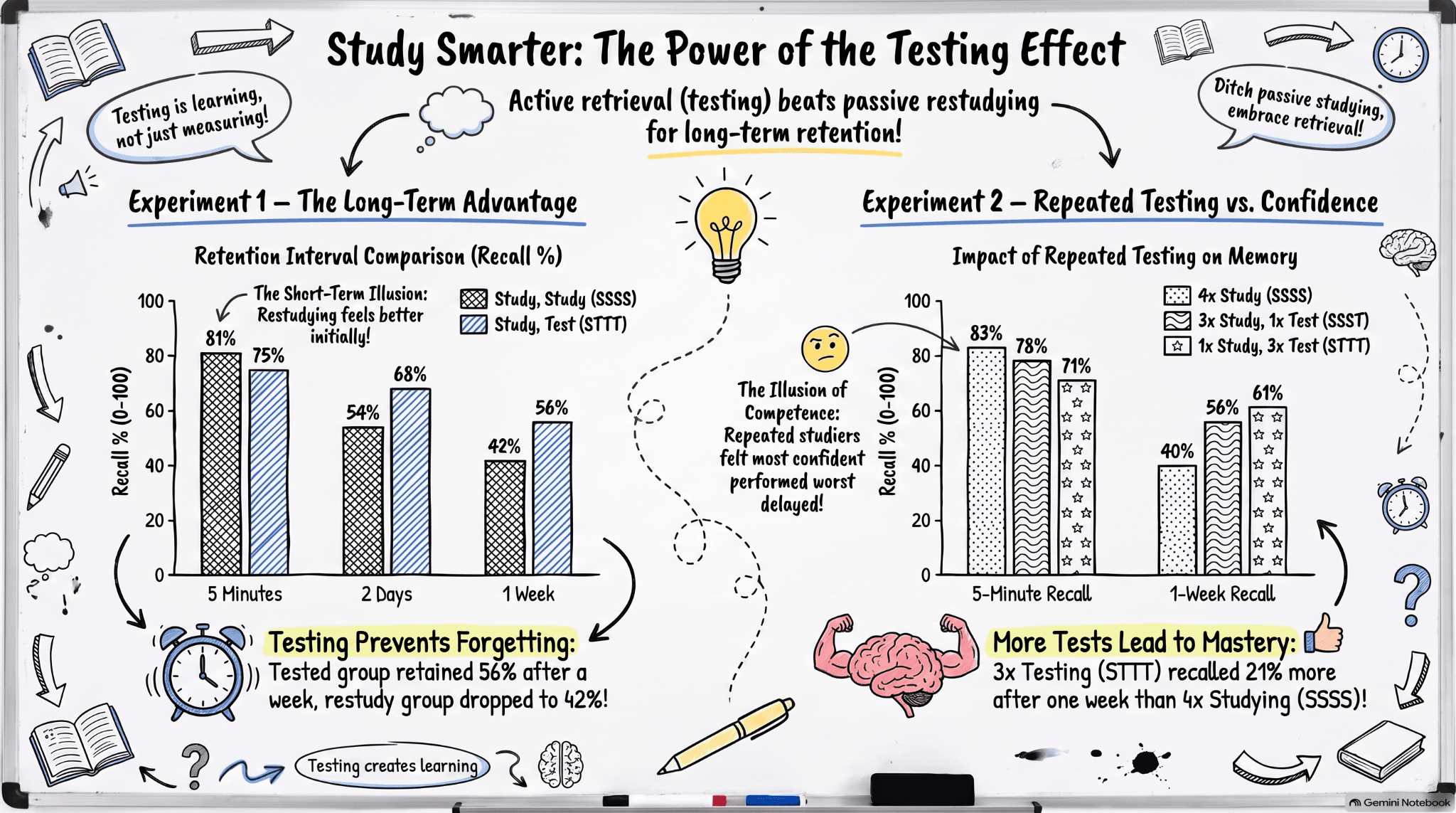
In the first experiment, 120 students were split into two groups. Both had to read two prose passages ("The Sun" and "Sea Otters") selected from a TOEFL reading comprehension book. They then restudied one passage for another 7 minutes and took a single 7-minute free-recall test on the other, with no feedback.
But the procedure for both groups was different. Researchers then split the students by how long they had to wait for the final 10-minute recall test: 5 minutes, 2 days, or a week.
Both groups took a final 10-minute free-recall retention test after their assigned delay interval.
The group that had taken recall tests after a week remembered significantly more (56%) than the students who had simply restudied (42%).
The second experiment split 180 students into three groups, and they had to follow this procedure:
- Group 1: 4 study sessions (SSSS)
- Group 2: 3 study sessions followed by a test (SSST)
- Group 3: 1 study session followed by 3 tests (STTT)
This experiment also had similar findings. The group that took the most tests recalled the most after a week.
The researchers also asked students to predict how well they'd remember the passage in a week. The pure-study group was the most confident but they finished last.
2. Even failed retrieval attempts help you learn (2009)
Researchers from the University of California, Los Angeles (UCLA) went further and proved that even unsuccessful retrieval attempts enhance learning, given that you get feedback afterward.
They conducted six experiments on UCLA undergrads where they were deliberately given questions they had no way of knowing the answer to, so participants never got the answers right.
After each attempt, they were shown the correct answer. In each experiment, this group was compared against another group that was shown the question and answer together; i.e., they weren’t made to recall the answers.
On the final test, the group that tried to recall but failed, then saw the answer, consistently outperformed the group that just studied the answer without having to recall it.
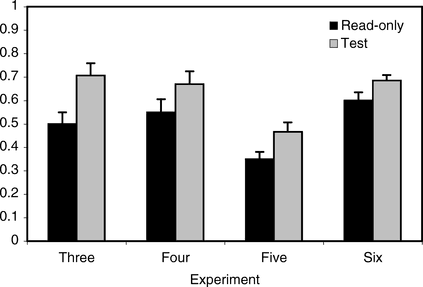
The recall group's percentage of correct answers was higher in all experiments. But what caused this?
The authors of the study propose three key cognitive reasons:
- When you actively try to produce an answer from memory, the search process activates a broad web of related concepts that you already know. This web primes your brain to absorb the correct answer once it is finally shown.
- When you are shown the correct answer in feedback, your brain suppresses the incorrect paths in memory that you explored when trying to look for the answer. As a result, future recalls become easier and more correct.
- The incorrect guesses or related concepts generated during the test can act as stepping stones to help you get to the right answer in future retrievals.
How to practice active recall: 5 best activities
Now let’s learn about the multiple learning techniques that implement the active recall method.
1. Flashcards
No technique implements the active recall method like flashcards because they force you to retrieve what’s on the back of the card by design.
But for flashcards to be actually effective, you need to stay honest in the review and avoid flipping the card to take hints or see the answer.
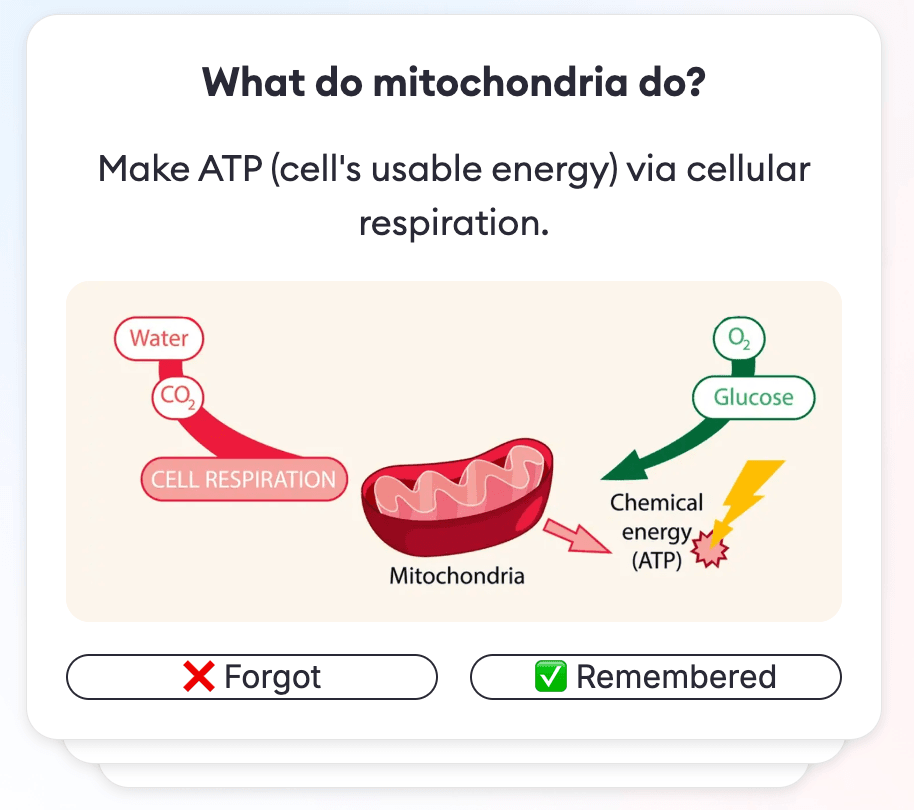
You’ll see the best results with flashcards if you schedule your review sessions using the spaced repetition method.
In spaced repetition, the gap between review sessions gets longer as you get better at the cards. You bait your brain into nearly forgetting information by taking longer breaks and then recall the information just when you’re about to actually forget.
The best thing about this technique is that there are flashcard apps like RemNote which make you practice active recall using the spaced repetition method. RemNote organizes your cards and schedules them for you. You only focus on practicing.
You can try RemNote for free to create flashcards and see the difference in how well you retain information.
2. Brain dumps
In a brain dump exercise, you write down everything you can remember about a topic without touching your notes or other materials.
Once you have dumped your brain, you open your material and cross-check what you got right and what you got wrong. You also get to know about the things you missed entirely.
Brain dumps are best for checking your grasp of bigger topics instead of isolated facts. Once you have found out what you are weak at, you can focus most of your attention on that entirely.
3. Practice tests and quizzes
Practice tests and quizzes are among the most direct ways to implement active recall.
If your course comes with past papers or end-of-chapter questions, you can use them to practice active recall.
But if you don't have ready-made questions, you can use tools like RemNote to autogenerate quizzes from your notes and other documents. RemNote also supports handwritten notes.
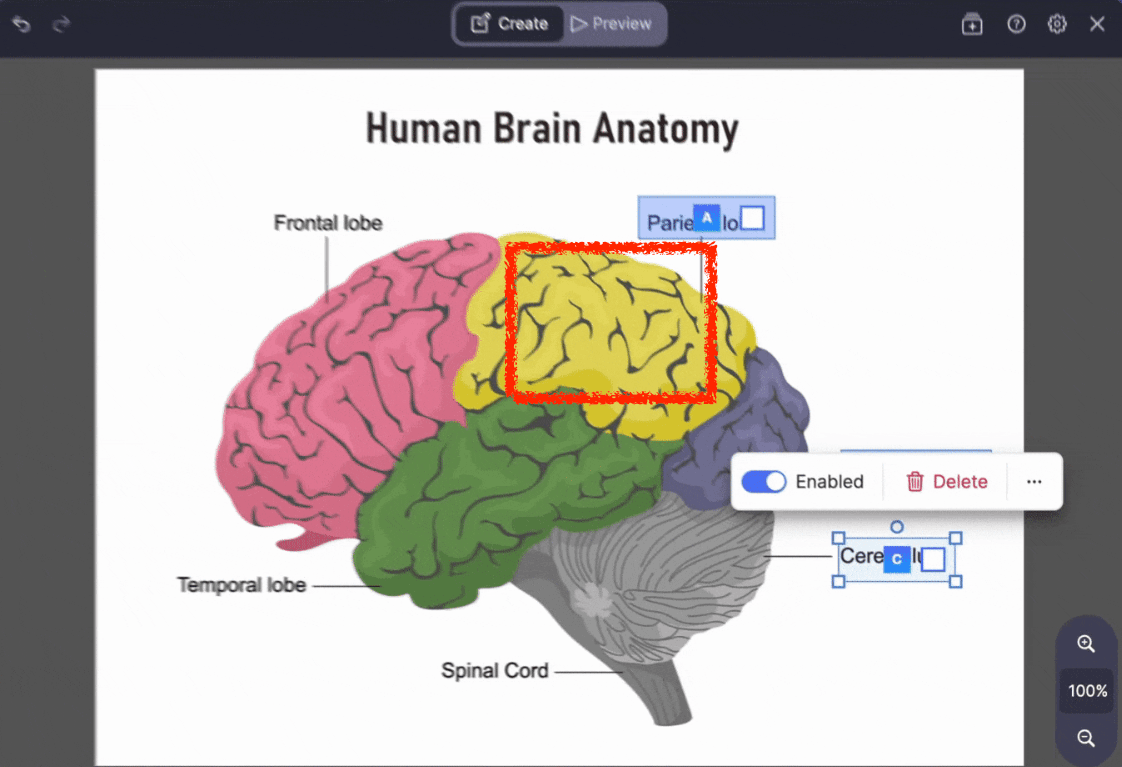
Make sure you don’t save practice tests for the very end of the semester. You need to conduct them at regular intervals, like how active recall sessions are supposed to happen.
4. The stop-and-recite method
In this method, you take a passive activity like reading and add an active recall session to the end of it.
Let’s say you’re reading a chapter. Instead of reading it entirely straight through, you stop at the end of each section and try to recite or summarize what you just covered in your own words. Make sure you are looking away from the source.
Only after you've done that do you continue to the next section. It also makes a big impact if you read and then recall whatever you can remember out loud.
Stopping for this activity after every few paragraphs forces your brain to reconstruct information from memory while it's still fresh.
5. The Feynman technique
The Feynman technique is named after the Nobel laureate physicist Richard Feynman, who said that if you cannot explain a concept in simple language to someone who knows nothing about it, then you don’t truly understand it yourself. If you can do this, then you truly understand it.
The method suggested for achieving this is called the Feynman technique.
You have to pick a concept that you’re trying to learn and try to explain it to someone from memory. This activity can happen either orally or on paper. Just make sure that you explain the concept in the simplest words you can manage. Avoid using technical terms because that can mean you yourself don’t know exactly what that term means.
Where exactly you stumble or get vague during this activity will surface gaps in your understanding. Those gaps are what you need to work on. Go through your notes to better understand the concepts where you got stuck, then try explaining the topic again.
Over time, you’ll be able to explain it fully without stumbling and in simple language.
The added benefit of the Feynman technique is that it’s ideal for building a deep understanding of conceptual subjects, in addition to just memorizing isolated facts.
Note: Feynman himself didn’t invent this technique, although the underlying idea is his. The technique was named and popularised long after his death.
Practice active recall the easy way with RemNote
You have already been introduced to RemNote a little in the article.
RemNote is a note-taking and flashcards app that makes active recall and spaced repetition a natural part of studying.
The app lets you take notes inside it and create a flashcard from any line as you type. So you take notes and create flashcards with minimal effort.
RemNote can also create flashcards from handwritten notes, PDFs, web pages, YouTube videos, presentations, and more.
Once your flashcards are ready, RemNote also organizes and schedules them using the spaced repetition method. You simply have to be present for active recall sessions where you are prompted to review flashcards.
RemNote also maintains a detailed history of your progress on flashcards.
I have only scratched the surface of what you can do with RemNote.
Sign up for RemNote for free and test the efficacy of active recall with RemNote for yourself.